A living archive of ideas—where scholarship meets storytelling, and analysis is deepened by imagination

EcoNobel : Where Nobel ideas meet real economies
EcoNobel decodes Nobel Prize–winning economics to explain how innovation reshapes markets, disrupts industries, and drives long-term growth—one idea at a time.
ANUBHAV KASHYAP
1/10/20264 min read
Human history can be seen as a mountain goat climbing uphill. It moves forward, changes direction, avoids obstacles, and struggles along the way—until it finally reaches the peak. For us, that peak represents an achievement: something that guides progress, gives direction, and creates a foundation for future generations. And just as there are always more mountains to climb, there will always be new heights for humanity to reach.
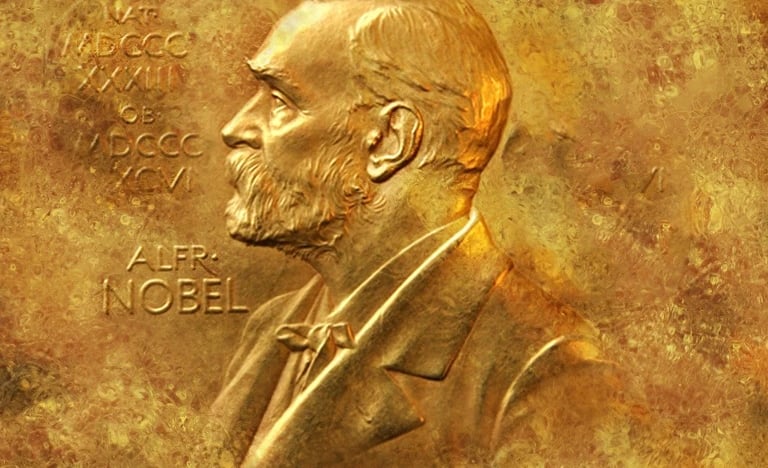
Such an achievement, is the Nobel Prize in the memory of Alfred Nobel, the father of dynamite. This honor is given out as a recognition of excellence in the field of innovation and research. Following Alfred Nobel’s 1895 will, the Nobel Prizes were initiated and the first prize was awarded in 1901 following the 5th year anniversary of Alfred Nobel’s death. The original prizes recognized achievements in physics, chemistry, physiology or medicine, literature, and peace—fields Nobel believed were central to human progress. This act of honoring people whose work brought “greatest benefits to mankind” though the Nobel Prize was seen differently than other honors since its inception. It stood out because it did not emphasize on rewarding power, popularity, or immediate success, it focused on a lasting impact which will motivate future generations to work and be better. Many received this honor as a result of their sheer hard work dedicated to the betterment of humanity.
Alfred Bernhard Nobel was a Swedish chemist and an engineer. He was born in 1833 in Stockholm, Sweden and was raised by a family of engineers. This isn’t just a co-incidence that he followed his father’s legacy and became an engineer; he was strongly oriented by his family, had a keen interest in innovation and combined with skills in chemistry and physics he started his own path of innovation. Fluent in six languages and an avid learner, he filed his first patent at the age of 24. He bought the Bofors iron and steel mill in 1894 which he converted into a big armaments manufacturer. More than just being a chemist and an engineer, he was popularly known as an inventor.
The most notable inventions include the dynamite, a powerful shock resistant explosive which he patented in 1867, and the ballistite, a precursor to many smokeless explosives such as the British smokeless powder “cordite” which was patented in the year 1887. Earning his living mostly through his 355 inventions, he amassed a fortune. Upon his death, Nobel donated his fortune to fund the Nobel Prizes. Nobel was later elected as a member of the Royal Swedish Academy of Sciences, which, pursuant to his will, is responsible for choosing the Nobel laureates in Physics and in Chemistry.
Seeing news about Nobel Prizes today is indeed fascinating, but one familiar name that pops up in everyone’s mind whenever someone hears something about relativity and its equation, is Albert Einstein. Prof Einstein was awarded the Nobel Prize in Physics in 1921 for his contributions to theoretical physics, particularly for explaining the photoelectric effect. His work showed that light behaves as particles, called photons, capable of knocking electrons out of a metal surface—an idea that became fundamental to quantum theory. Notably, the prize was not given for his theory of relativity, which was still viewed as controversial at the time. His groundbreaking findings and ideas have shaped the modern world of theoretical physics in such a manner than somehow, somewhere, his principles and ideas are in effect.
Madam Curie, another famous laureate, was the first woman to win the Nobel Prize award and the only person to receive this honor in two separate fields of science. She received the Nobel Prize in Physics (1903) and the Nobel Prize in Chemistry (1911) for her research on radioactivity, the discovery of polonium and radium, and the development of mobile X-ray units during WW1. Her contributions left a lasting impact in the fields of chemistry, physics and biology and especially in the field of cancer treatment, where without the utilization of X-rays, the possibility of detection would have been somewhat impossible. Such is, the nature of the Nobel prize and its recipients.
We have been focusing a lot about the field of science, namely Physics, Chemistry and Mathematics, when it comes to the Nobel Prize. But one of the most important and respected fields which was taken into consideration after about 67 years of Nobel Prize honoring is, Economics. This is because, by the mid-20th century, economic ideas and discoveries were shaping the growth of nations, and was developed into a rigorous, scientific discipline.
In 1968, the Sveriges Riksbank or the Swedish Central Bank, the world’s oldest central bank, was celebrating its 300th anniversary. To mark the occasion, it donated funds to the Nobel Foundation to establish a new prize in economic sciences, explicitly “in memory of Alfred Nobel.” The Sveriges Riksbank Prize in Economic Science in Memory of Alfred Nobel was established by the Sveriges Riksbank the very same year, recognizing excellence in the field of economic sciences and follows the same principles as for the Nobel Prizes that have been awarded since 1901. The prize is funded by the bank and grew into popularity due to heavy reliance of economic principles by the governments during the World War 2 and Cold War era. Basically, since economics studies how society, or to be accurate, an economy functions, its importance cannot be undermined.
This prize is awarded by the Royal Swedish Academy of Sciences, Stockholm, Sweden. As of 2025, a total of 57 prizes has been awarded to 99 laureates in the field of economics which accounts for about 9% of the total 633 prizes given out in all fields combined. The first prize was awarded in 1969 to two great economists, Ragnar Frisch from Norway and Jan Tinbergen from Netherlands for pioneering econometric models that laid the foundation for modern quantitative economic analysis. Their contribution has aided the development and evolution of quantitative economic analysis, giving birth to various forecasting models branching out from their foundational groundwork.
The work of the recipients of the Nobel Prize in Economics has veered the course of human history with significant changes in the way economists view economics – in the way people view economics. Economics deals with management, management of scare resources and how they satisfy the needs of the people. This field has come a long way, from the on-set of control and dominance during the stone age to the current geopolitical scenario. Society, or to be precise, economies have come a long way from the famous barter system to the monetary system. From well set trading systems to the infamous black markets. From anarchies to democracies.
Keeping all the examples aside, I invite you to journey with me – a journey through time where we will go backwards, little by little, year by year. We will discover how the work of the present Nobel laureates has played significant impact in our society, and how they have taken inspiration from the wonderous contributions of the past. Each laureate’s work will be uncovered and studied. This journey will be full of learning, mysteries, analysis, criticisms and most importantly, the application of economics in the practical way.
I present to you “Eco-Nobel: Where Nobel Ideas meet real economies”
WORK IN PROGRESS
© 2026. All rights reserved.




Reach out for questions & collaboration
+91-9954060665