In Memory of a Ghost
Your path is solitary,
restless like moon-wake.
Why accuse the road at all—
let the mind go where it will.
That alone is right—
that alone, truth.
Clouds hang like soap-foam.
Leaves pale into turmeric gold.
Rain waits
somewhere along your way.
When I search for you,
the sun slips and falls upon my head.
My fingers scatter into flight.
I question the roads. The dust shivers.
You remain stone-still in the river’s bend.
I peer into houses—
each doll opens a window.
Doors remain shut.
When I speak of love,
you begin counting age.
I speak of coconut blossoms.
You summon a storm.
Golden flowers fall.
A rattling train passes.
A broken star sinks into mud.
A lone casuarina loosens its hair to the wind.
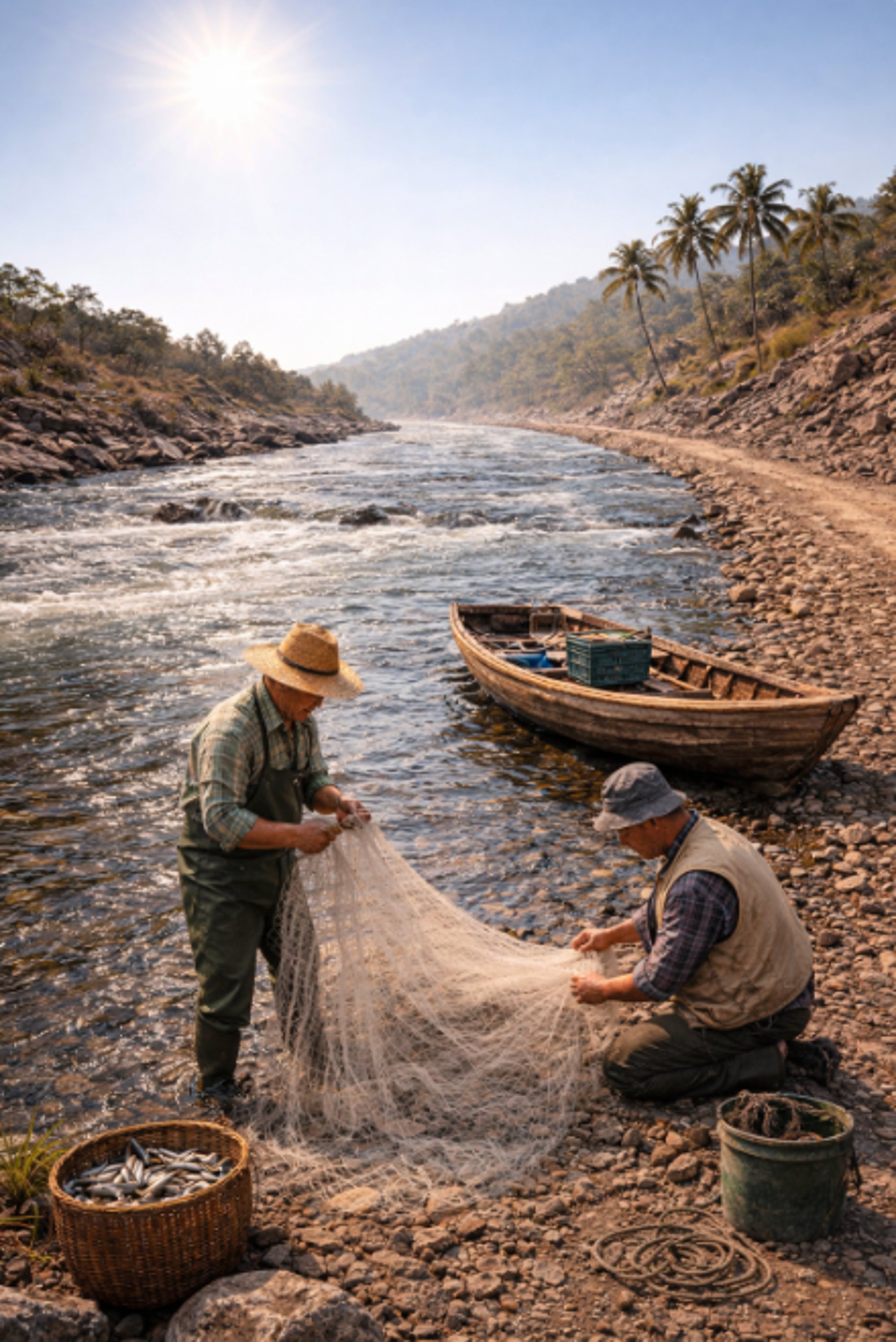
We both go fishing.
A river edges closer.
The boat is of paper.
The net is woven of mist and moonlight.
In shallow water, the fish hook me.
Your steam-boat moves on.
Silver fish writhe in the net.
By morning, both boats
sink into sand.
We both set out to wayfaring the country,
secretly—quietly.
Along the mountain’s flank
in the sway of leaves and branches
we recite poems of love.
The road back is lost.
You carve a new path and walk ahead,
trying to sketch the blue sky,
in the black of charcoal.
When I speak of death,
you smash the clocks.
“Someday we’ll go to Sonapur,” you say.
A cup of apong.
A piece of roasted meat.
Fire will flare and pulse.
Rupsing Atoi will tell tales of love.
The mind will grow light.
Your path is solitary,
restless like moon-wake.
_____________________________________
29 January 1993, Guwahati – April 2006, Tezpur
First published: Rangghar, November 1994
Editor’s Note
Sonapur: An imaginary countryside. It has no resemblances with Sonapur, Assam
Apong: It is a traditional, organic rice-based alcoholic beverage primarily prepared by the Mishing community of Assam. It is more than just a drink, it is a sacred element of their cultural identity.
Atoi: This salutation does not have a single-word English equivalent. A Vaishnavite Monk may be of a closer identity.
In Memory of a Ghost is not an elegy for the dead alone, but for an enduring presence that resists disappearance. The “ghost” here inhabits memory, love, time, and contradiction—sometimes companion, sometimes refusal.
The poem moves through landscapes both real and dreamlike: roads, rivers, houses, trains, and journeys collapse into one another, mirroring the instability of attachment. Images recur in altered forms—boats sink, paths vanish, clocks are broken—suggesting that linear time cannot hold what has been lost or transformed.
The journey is ultimately asymmetrical. While the speaker lingers, questions, and remembers, the other continues forward, carving paths into uncertainty. What remains is not closure, but motion—moonlit, restless, and unresolved.
Select language
© 2026. All rights reserved.




Reach out for questions & collaboration
+91-9954060665